
Last updated July 7, 2026
Garage Door Permits, Codes & Inspections in FL: What You Need to Know
Here’s a hard truth most Miami homeowners don’t learn until it’s too late: that unpermitted garage door replacement you had done three years ago? It’s now a cloud on your title. When buyers run a permit history during closing — and they always do in Miami-Dade — unpermitted structural work surfaces instantly. We’ve seen deals delayed or killed over a $2,500 door that should have carried a $150 permit. In this guide, we’ll walk you through exactly which garage door projects trigger permits in Florida, what Miami-Dade’s High Velocity Hurricane Zone (HVHZ) compliance actually requires, how to verify your contractor pulled the right permits, and why skipping this step creates liability that compounds over time.
Quick Answer
Most garage door replacements in Miami-Dade require a building permit because the county sits in Florida’s High Velocity Hurricane Zone. Simple repairs — spring replacement, opener swaps, roller fixes — typically don’t. Permits run $150–$400, inspections verify wind-load ratings and proper anchorage, and unpermitted work must be disclosed at resale under Florida law. The safest path: confirm your contractor pulls the permit before work begins.
Table of Contents
- When Do Garage Door Projects Require a Permit in Miami-Dade?
- What HVHZ Compliance Actually Requires at Inspection
- How to Pull a Permit: Homeowner vs. Contractor Routes
- Permit Timeline and Costs in Miami-Dade
- Resale Disclosure Consequences of Unpermitted Work
- Common Mistakes to Avoid
- When to Call a Professional
- Frequently Asked Questions
When Do Garage Door Projects Require a Permit in Miami-Dade?
Florida’s building code, adapted from the International Building Code with state-specific amendments, delegates permit authority to counties and municipalities. Miami-Dade enforces some of the strictest thresholds in the state because of its HVHZ designation — wind speeds that can exceed 175 mph in a Category 5 storm.
Here’s the practical breakdown we use when advising Miami homeowners:
Projects That REQUIRE a Permit
- Full door replacement: Removing an existing garage door and installing a new one, even if dimensions stay identical. The structural connection to the building envelope changes.
- Opening modifications: Widening, heightening, or reconfiguring the garage door opening in any way.
- Converting to hurricane-rated door: Upgrading from a standard door to HVHZ-compliant assembly — common in older Miami homes built before 1994.
- New construction installation: Any door in a newly built garage or addition.
- Structural frame replacement: Replacing or modifying the header, jambs, or anchorage system that connects the door to the building.
Projects That Typically DON’T Require a Permit
- Like-for-like repairs: Spring replacement, cable repair, roller swap, track realignment, or panel replacement within the existing door assembly.
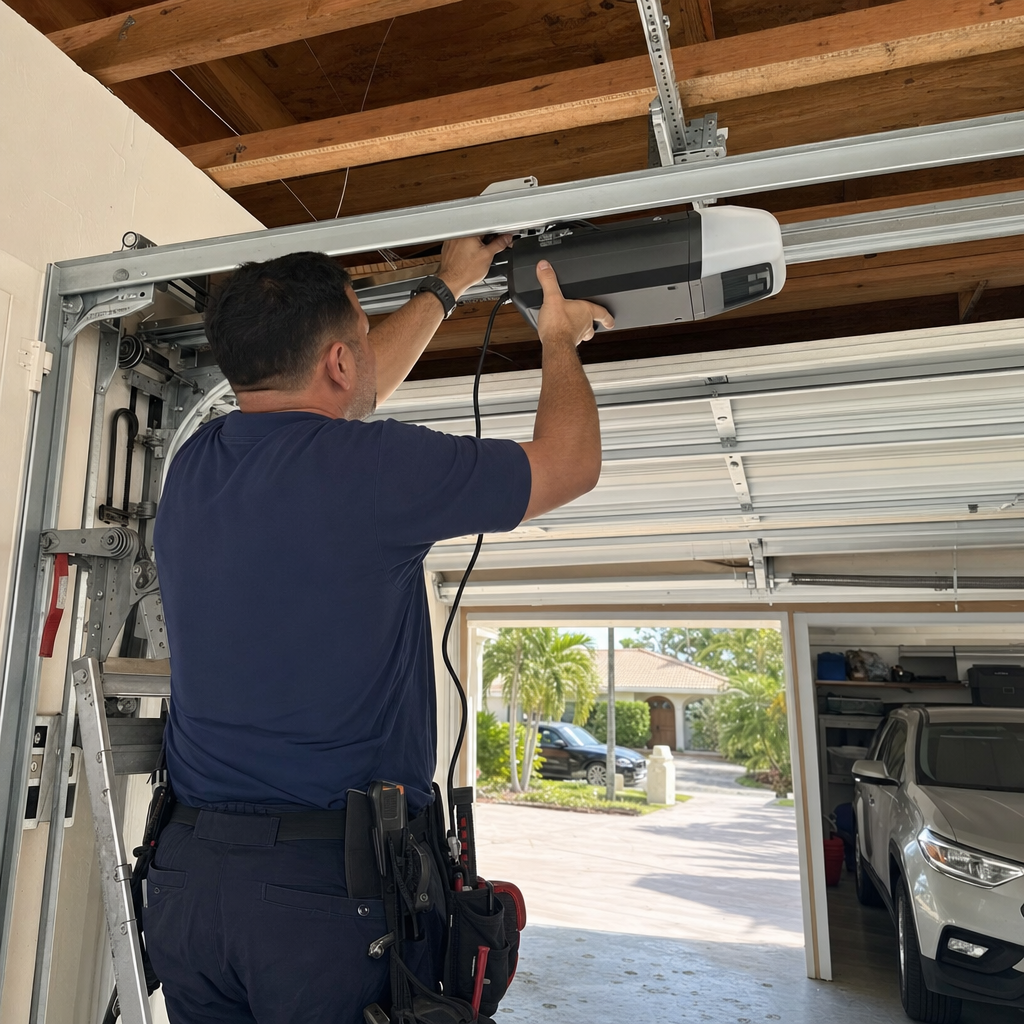
- Opener replacement: Swapping a garage door opener unit without modifying electrical service or structural mounting.
- Weatherstripping and seal replacement: Peripheral maintenance that doesn’t alter the door’s structural performance.
- Cosmetic refinishing: Painting, staining, or hardware replacement that doesn’t affect operation or safety.
The “like-for-like” exemption trips up a lot of Miami homeowners. If your 1987 garage door finally fails and you install a modern insulated steel door with the same rough opening, that’s not like-for-like in the eyes of Miami-Dade Building. The new door has different weight, wind-load characteristics, and anchorage requirements. It needs a permit.
We’ve worked in neighborhoods from Norland to Coral Gables to Miami Beach, and the permit rules don’t vary — Miami-Dade enforces countywide. The only variation is how aggressively your specific municipality spot-checks. Pinecrest and Palmetto Bay tend to be meticulous; some unincorporated areas less so. But the code is the code.
What HVHZ Compliance Actually Requires at Inspection
This is where Florida garage door permitting diverges sharply from most of the country. In Miami-Dade, your garage door isn’t just a moving wall — it’s a critical component of the building envelope that must resist pressurization, impact, and cyclic loading during a hurricane.
When the inspector arrives, they’re checking three specific things. Understanding this ahead of time prevents surprises.
1. Wind Load Rating and NOA Documentation
The inspector will ask for the Notice of Acceptance (NOA) — Miami-Dade’s product approval document — for your specific door model. This isn’t a generic spec sheet. It’s a county-issued certificate proving the door assembly (door, track, hardware, and anchorage) passed HVHZ testing.
Key numbers they’ll verify:
- Design pressure rating: Must meet or exceed the calculated load for your home’s exposure category and height. In coastal Miami, this often means +50/-50 psf or higher.
- Missile impact rating: For doors in the wind-borne debris region (essentially all of Miami-Dade), large-missile impact resistance (9-pound 2×4 at 34 mph) is required unless the garage is fully protected by impact-rated coverings.
- Cyclic pressure testing: The door must survive 4,500 positive and negative pressure cycles without failure.
We work with Amarr and Wayne Dalton doors that carry Miami-Dade NOAs, and we always provide the documentation packet before inspection. If your contractor can’t produce the NOA number on request, stop the project. An inspector won’t pass a door without it.
2. Anchorage and Structural Connection
The inspector will physically examine how the track system connects to the garage structure. In Miami’s HVHZ, standard wood-frame attachment often isn’t sufficient.
What they check:
- Track bracket spacing: Typically maximum 24 inches on center, with closer spacing near jambs and corners.
- Fastener type and embedment: Minimum 3/8-inch diameter lag screws or approved anchors into solid framing or concrete, with full embedment depth per the NOA.
- Header capacity: The structural member above the door must handle the door weight plus wind uplift. We’ve seen Miami homes where a 16-foot opening needed a engineered LVL header replacement to meet current code.
- Jamb condition: Rot, termite damage, or inadequate dimension lumber gets flagged immediately — common in older Miami homes with original garage construction.
3. Operational Safety Components
Finally, the inspector verifies the door operates safely:
- Spring balance — door stays at mid-travel without drifting
- Auto-reverse function on opener (if present)
- Photo-eye alignment and obstruction response
- Emergency release accessibility
Here’s the reality: about 15% of garage door installations we encounter in Miami fail first inspection, almost always for anchorage or documentation issues. A qualified contractor anticipates this. We schedule the inspection only after verifying every NOA detail and torque-testing every fastener.
How to Pull a Permit: Homeowner vs. Contractor Routes
You have two paths to permit compliance in Miami-Dade. Each carries different risks and responsibilities.
Option 1: Homeowner Pulls the Permit
Miami-Dade allows homeowners to act as their own contractor on single-family residences they occupy. Here’s the actual process:
- Complete the Owner-Builder Disclosure Form: Available through Miami-Dade’s online portal. This document states you understand you’re assuming contractor liability.
- Submit permit application with plans: For garage doors, this typically requires the door manufacturer’s NOA, a site plan showing door location, and sometimes a structural detail of the header connection. Simple replacements often qualify for “express” review.
- Pay permit fees: We’ll cover exact costs in the next section.
- Schedule inspections: Rough inspection (if structural work) and final inspection after installation.
- Obtain Certificate of Completion: Required to close the permit and remove it from active status.
The catch: as owner-builder, you are the liable party if installation fails inspection, causes property damage, or injures someone. Your homeowner’s insurance may not cover defects in work you directed. And if you hire unlicensed labor to execute, you assume their liability too.
We’ve had Miami homeowners call us after a failed inspection on their self-managed project. The fixes cost more than our original quote would have, and the permit clock was running — Miami-Dade starts enforcement proceedings if permits expire without completion.
Option 2: Licensed Contractor Pulls the Permit
This is what we recommend, and it’s what Apex Garage Door Service Florida home handles for every qualifying project. The process looks similar, but the liability shifts:
- Contractor submits application under their license: They carry the professional liability and workers’ compensation coverage.
- Contractor provides all documentation: NOA, product specs, installation details — this is their expertise, not yours to research.
- Contractor schedules and attends inspections: They know the inspectors, the common failure points, and how to correct deficiencies quickly.
- Certificate of Completion issued to contractor, copied to homeowner: Clean record for your property file.
How to Confirm Your Contractor Actually Pulled the Permit
This is critical. We’ve encountered Miami homeowners who paid a contractor “for the permit” only to discover nothing was filed.
Verify before work begins:
- Ask for the permit application number and check it on Miami-Dade’s online permit search (available 24/7)
- Confirm the permit lists your property address and the specific scope of work
- Verify the contractor’s name matches the license holder — not a subcontractor or unlicensed worker
- Request that inspection scheduling happen only after you’re notified, so you can attend if desired
Red flags: a contractor who asks you to pull the permit “to save money” while they do the work; anyone who says permits “aren’t needed for this job” when replacement is clearly involved; or a quote that’s significantly lower than competitors because permit costs aren’t included.
Permit Timeline and Costs in Miami-Dade
Understanding realistic timelines prevents project disruption. Here’s what we’ve experienced across hundreds of Miami installations:
Permit Costs (2024–2025 Structure)
| Fee Component | Typical Range |
|---|---|
| Base building permit (garage door replacement) | $85 – $150 |
| Plan review fee (if required) | $50 – $100 |
| HVHZ surcharge | $25 – $50 |
| Inspection fees (initial + re-inspection if needed) | $50 – $100 |
| Total typical range | $150 – $400 |
Complex projects — structural header modifications, impact-rated upgrades in wind-borne debris zones, or historic district work — can push costs toward the higher end. Miami Beach and Coral Gables sometimes layer municipal fees on top of county charges.
Timeline Expectations
| Phase | Typical Duration |
|---|---|
| Application submission to permit issuance | 3 – 10 business days |
| Installation work (once permitted) | 4 – 8 hours for standard door |
| Inspection scheduling (after completion) | 1 – 3 business days |
| Re-inspection (if first fails) | 3 – 7 additional days |
| Certificate of Completion | 1 – 2 business days after passing |
Total realistic timeline: one to three weeks from application to closed permit, assuming no re-inspections. We’ve completed same-week in emergencies where the permit was pre-cleared, but that’s the exception.
Seasonal factors matter in Miami. Permit offices slow before hurricane season (inspectors get redeployed) and after major storms (backlog from damage assessments). Planning your garage door replacement for spring or fall typically yields fastest turnaround.
Resale Disclosure Consequences of Unpermitted Work
This is the section most competitors gloss over, and it’s where Miami homeowners get hurt financially.
Florida law requires sellers to disclose material facts affecting property value. Under Florida Statute § 475.278 and standard residential contract provisions, unpermitted structural work qualifies as a material fact. Garage doors are structural — they’re part of the building envelope, affect insurance ratings, and influence wind mitigation credits.
How Unpermitted Work Surfaces
Buyer due diligence in Miami typically includes:
- Permit history search: Available online through Miami-Dade’s portal — takes five minutes, costs nothing
- Title insurance requirements: Underwriters may exclude coverage for unpermitted improvements or require indemnification
- Lender conditions: Many mortgage underwriters flag unpermitted structural work as a condition to close
- Wind mitigation inspection: Required for insurance discounts; unpermitted door may not qualify for credits even if technically compliant
Financial Impact We’ve Observed
The scenarios aren’t hypothetical. In our 11 years serving Miami, we’ve been called to remediate unpermitted installations where:
- A South Miami seller had to reduce asking price by $8,000 when unpermitted 2019 door replacement surfaced — the cost to permit retroactively, plus buyer’s negotiated discount for hassle
- A Little Havana closing was delayed 6 weeks while a retroactive permit was pursued; the original installer was out of business, forcing the seller to hire us to document and re-inspect work we didn’t perform
- An Aventura condo sale fell through entirely when the buyer’s lender refused to fund with unpermitted garage door work on the building’s common element
Retroactive permitting — “legalizing” work after the fact — is possible but painful. Miami-Dade requires opening walls to verify concealed connections, engineering review of work not originally documented, and sometimes destructive testing. Costs routinely exceed original installation pricing.
The bottom line for Miami homeowners: permit compliance isn’t bureaucratic box-checking. It’s asset protection.
Common Mistakes to Avoid
- Assuming “same size” means “no permit needed.” Miami-Dade evaluates door assemblies, not just dimensions. A modern insulated steel door with wind rating replaces a 1990s uninsulated aluminum door — different product, different performance, permit required.
- Trusting verbal assurance that a permit was pulled. We’ve met Miami homeowners who discovered the “permit” their handyman promised was actually just a business tax receipt. Always verify the actual permit number in the county system.
- Buying a door online to “save money,” then hiring cheap installation. Big-box and online retailers sell doors without verifying HVHZ compliance. That “great deal” becomes worthless when the inspector rejects it for lacking Miami-Dade NOA. We work with brands like Craftsman and Raynor that maintain current Florida approvals.
- Ignoring the header condition. Miami’s humidity and termite pressure mean original garage door headers often degrade hidden behind trim. We inspect structurally before quoting — skipping this risks permit rejection and safety hazard.
- Scheduling installation before permit issuance. Some contractors do this to “keep the job moving.” If inspection fails, you’re paying twice. We don’t start work until permit is active and inspection window is scheduled.
- Failing to close the permit after passing inspection. An open permit becomes a cloud on title just like an unpermitted project. Confirm your contractor obtains the Certificate of Completion and provides you a copy.
- Disclosing “I don’t know” on seller disclosures. If you genuinely don’t know whether prior work was permitted, state that specifically — but understand that buyers will investigate. Proactive permit verification before listing prevents surprises.
When to Call a Professional
Garage door permitting intersects with structural engineering, product compliance, and municipal process — it’s not a casual DIY project in Miami’s regulatory environment. Call a qualified professional when:
- You’re replacing any garage door in Miami-Dade — permit complexity is guaranteed
- Your home was built before 1994 and may need HVHZ upgrade compliance
- The existing door shows wind damage, corrosion, or operational failure — these symptoms often indicate deeper structural issues
- You’re preparing to sell and need to verify permit history before listing
- You’re buying a home and want pre-purchase assessment of garage door condition and compliance
At Apex Garage Door Service Florida, we handle permit pull, NOA documentation, installation, and inspection scheduling as an integrated service. Robert Garcia serves as lead technician on every job — the owner shows up, and he’s your technician. With 11 years focused exclusively on garage doors and opener systems, we navigate Miami-Dade’s requirements without the learning curve that delays less specialized contractors. Apex Garage Door Service Florida home offers free estimates in Miami — call (888) 572-6026 to discuss your project and confirm exactly what permitting your specific job requires.
Frequently Asked Questions
Most residential garage door replacement permits in Miami-Dade cost between $150 and $400 total, including base permit, plan review, HVHZ surcharge, and inspection fees. Complex projects with structural modifications or historic district overlay can run higher. Call (888) 572-6026 for an exact quote on your specific job — estimates are free.
No — in Miami-Dade, “like-for-like” refers to the specific product assembly, not just dimensions. A new door with different wind-load rating, weight, or anchorage requirements triggers permit requirements even with identical rough opening. The only true no-permit scenario is repair of existing components without full assembly replacement.
From application to closed permit, expect one to three weeks for a standard residential garage door replacement. Permit issuance typically takes 3–10 business days, installation one day, and inspection scheduling 1–3 business days after completion. Re-inspections add 3–7 days if the first inspection identifies deficiencies.
Florida law requires disclosure of unpermitted structural work, and Miami-Dade permit records are publicly searchable. Buyers routinely discover unpermitted work during due diligence, leading to price reductions, closing delays, or deal cancellation. Retroactive permitting is possible but typically costs more than original compliance and may require destructive verification of concealed connections.
Typically no — a direct opener swap without electrical service modification or structural mounting changes usually qualifies as repair. However, if you’re adding a new opener where none existed, upgrading electrical circuits, or modifying the header attachment for opener reinforcement, permit requirements may apply. We assess this during our free estimate.
Request the permit application number and verify it on Miami-Dade’s online permit search portal before work begins. Confirm the property address, scope of work, and contractor name match exactly. The permit should be active (not pending or expired) and list the correct license holder — not a subcontractor or unlicensed individual. Reputable contractors provide this proactively; hesitation is a red flag.
The Bottom Line
Miami-Dade’s garage door permitting isn’t optional bureaucracy — it’s a hurricane-resilience requirement with real financial consequences for non-compliance. Know which projects trigger permits, understand what inspectors actually verify, confirm your contractor’s permit is legitimate, and protect your property’s marketability by closing every permit properly. The time invested upfront prevents exponentially larger costs at resale. For Miami homeowners navigating this process, working with a contractor who specializes in garage doors — not general handyman work — makes the difference between smooth compliance and costly surprises.
Written by Robert Garcia, Owner & Lead Technician at Apex Garage Door Service Florida, serving Miami since 2015.