
Last updated July 7, 2026
DIY vs Professional Garage Door: The Miami Homeowner’s Decision Guide
YouTube has great garage door DIY tutorials. Almost none of them mention that installing your own door in Miami-Dade without a licensed contractor voids your wind mitigation insurance credit and creates an unpermitted structure — two consequences that cost far more than the labor you saved. In our 11 years serving Miami, we’ve met dozens of homeowners who learned this the hard way after a failed inspection or denied claim. This guide draws the exact line between what you can safely handle yourself and what Florida law, insurance requirements, and genuine physical danger make strictly professional territory.
Quick Answer
Most Miami homeowners can safely DIY sensor alignment, remote programming, and weatherstrip replacement. Everything else — spring repair, cable replacement, track adjustment, and full door installation — legally requires a licensed contractor in Florida’s High Velocity Hurricane Zone, and attempting it yourself risks injury, voided insurance credits, and unpermitted structure penalties.
Table of Contents
- What Florida Law Actually Allows You to DIY
- Why Spring Replacement Is the Most Dangerous DIY Job
- HVHZ Requirements: The Miami Difference
- How DIY Installation Affects Your Wind Mitigation Insurance
- The 3 Garage Door Tasks You Can Actually DIY in Miami
- The Break-Even Point: When Pro Labor Costs Less Than DIY Risk
- Common Mistakes to Avoid
- When to Call a Professional
- Frequently Asked Questions
What Florida Law Actually Allows You to DIY
Florida’s contractor licensing laws draw a sharper line for garage doors than most homeowners realize. Under Florida Statute 489.103, any “construction, repair, or improvement” to a structural component of a building requires a licensed contractor — and in Miami-Dade’s High Velocity Hurricane Zone, garage doors are explicitly classified as structural wind-resistant components.
Here’s what this means in practical terms:
- You can legally DIY: Opener remote programming, safety sensor alignment, battery replacement, exterior weatherstrip replacement, and cosmetic cleaning
- You legally cannot DIY: Door panel replacement, spring or cable repair, track realignment, roller replacement, and full door installation
- Gray area: Opener replacement — technically electrical work that may require a licensed electrician depending on wiring modifications
The distinction matters because Miami-Dade enforces these rules. We’ve been called to jobs in Coral Gables and Pinecrest where homeowners started a DIY installation, got stuck, and then couldn’t get a permit retroactively without tearing out their work. The county’s building department treats unpermitted garage door installations as priority violations because of their direct role in wind-load protection.
Permit requirements in Miami-Dade are specific: any new garage door installation requires a building permit, wind-load engineering documentation, and inspection by a certified building official. The permit application must list a licensed contractor. Homeowner permits exist for some trades, but not for HVHZ structural components — and garage doors in Miami unequivocally qualify.
We’ve seen the consequences firsthand. A homeowner in Garage Door Repair in Norland installed his own Clopay door after watching a tutorial. When he sold two years later, the buyer’s inspection flagged the unpermitted work. He paid $2,800 to have it permitted retroactively — more than our original installation quote.
Why Spring Replacement Is the Most Dangerous DIY Job
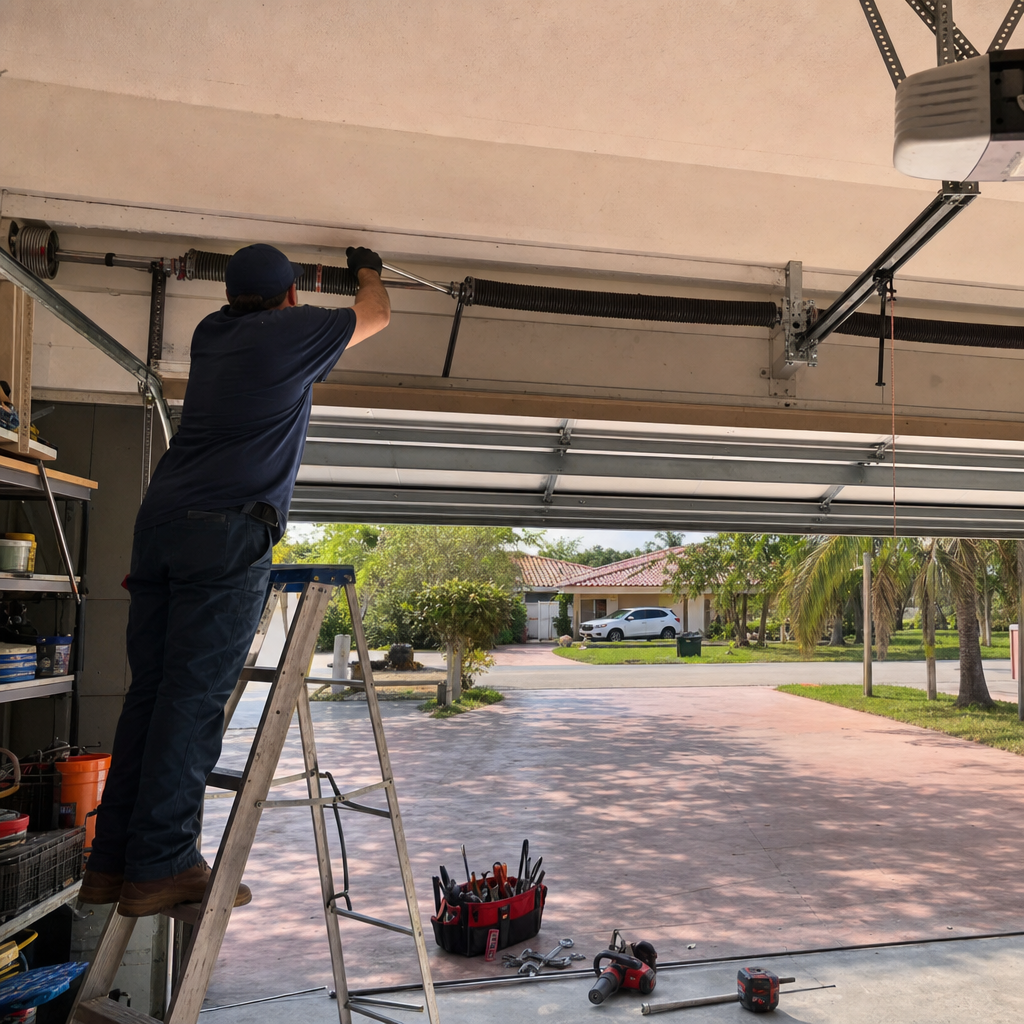
Garage door springs store massive mechanical energy. A standard torsion spring on a double-car door in Miami holds roughly 10,000 pounds of torque at full wound tension. When that energy releases unexpectedly — which it does when DIYers use wrong tools, wrong techniques, or underestimate the hazard — the results are catastrophic.
We’re not talking about bruised fingers. In our 11 years, we’ve encountered:
- A Hialeah homeowner who lost two fingers to a winding bar that slipped
- A Kendall DIYer who suffered a skull fracture when a broken spring launched across the garage
- Multiple laceration injuries from cable snap-back in Coconut Grove and Little Havana
The physics are unforgiving. Torsion springs require specific winding bars inserted into cogs while tension is systematically added or released. Extension springs contain energy through safety cables — which homeowners routinely remove because they “look unnecessary.” Neither system forgives a mistake.
Here’s what makes springs uniquely dangerous compared to other home repairs:
- Unpredictable failure mode: Springs can appear intact while holding dangerous residual tension
- No margin for error: A slipped wrench or wrong-size bar converts instantly to uncontrolled release
- Hidden deterioration: Miami’s salt air and humidity accelerate corrosion inside the spring coils, invisible until failure
- Wrong parts amplify risk: Homeowners frequently order incorrect spring specs — wrong wire gauge, wrong length, wrong wind direction — creating immediate danger on first operation
Professional spring replacement runs $180–$340 in Miami and takes 45–90 minutes with proper tools. The ER visit for a spring injury averages $8,500 before accounting for permanent disability. The math isn’t close.
We carry specific spring inventory for Miami’s common door sizes — 16×7 and 8×7 being standard in neighborhoods from Wynwood to Doral — because salt corrosion means springs here fail faster than national averages. When we replace springs, we also inspect cables, drums, and bearing plates because we’ve learned that Miami’s climate stresses the entire system, not just the broken component.
HVHZ Requirements: The Miami Difference
Florida’s High Velocity Hurricane Zone — Miami-Dade and Broward counties — operates under building codes that don’t exist elsewhere in the state. For garage doors, this means every installation must meet Miami-Dade County Product Control approval, with specific wind-load ratings tied to your home’s exposure category.
These aren’t bureaucratic checkboxes. They’re engineering standards developed after Hurricane Andrew demonstrated how garage door failure creates catastrophic pressure changes that rip roofs from structures.
Key HVHZ requirements that eliminate DIY installation:
- Product approval: Only doors with Miami-Dade Notice of Acceptance (NOA) can be legally installed
- Wind-load rating: Must match or exceed your home’s design pressure, typically +50 to -60 PSF in coastal Miami
- Installation method: Must follow the exact fastening pattern, track gauge, and reinforcement specified in the NOA
- Permit and inspection: Required for every installation; inspector verifies product label matches approved assembly
We’ve inspected DIY installations in Miami Beach and Brickell where homeowners used perfectly good doors — just not HVHZ-approved models. Those doors had to be completely removed. The “savings” from online purchasing evaporated instantly.
The owner shows up — and he’s your technician. When Robert Garcia evaluates a door for replacement, he verifies the existing framing can support HVHZ requirements and identifies whether your garage’s exposure category has changed due to new construction nearby. That’s the kind of site-specific assessment no tutorial provides.
How DIY Installation Affects Your Wind Mitigation Insurance
This is the hidden cost that transforms “DIY savings” into long-term financial damage. Florida’s wind mitigation inspection — required for insurance discounts — specifically verifies that garage doors are properly permitted, properly installed, and match approved HVHZ products.
Here’s how the inspection works and where DIY fails:
- Inspector checks permit history: Unpermitted installations are immediately flagged
- Product label verification: Inspector photographs the door’s Miami-Dade NOA label; missing or non-matching labels mean no credit
- Installation quality assessment: Track alignment, fastener spacing, and reinforcement are evaluated against approved methods
- Opening protection credit: Garage doors qualify for significant premium reductions — if they pass
The financial impact is substantial. A proper wind mitigation report with full garage door credit typically saves Miami homeowners $400–$800 annually on windstorm premiums. Over a 10-year ownership period, that’s $4,000–$8,000 in cumulative savings.
A DIY installation that fails inspection means:
- Zero opening protection credit
- Potential requirement to reinstall with proper permitting before insurance renewal
- Possible policy non-renewal if the unpermitted work is discovered during a claim
We’ve been called to homes in Aventura and Palmetto Bay where owners faced exactly this scenario — paying full professional installation costs plus permit penalties, years after their “successful” DIY project. The break-even analysis isn’t favorable.
The 3 Garage Door Tasks You Can Actually DIY in Miami
Not everything requires a service call. Here are the three tasks where DIY makes practical and legal sense, with specific Miami considerations for each.
1. Safety Sensor Alignment
Photo-eye sensors sit 4–6 inches above the floor on both sides of the door opening. When misaligned, the door reverses immediately or refuses to close. In Miami, ground settling and humidity-swollen door frames push sensors out of alignment more frequently than in drier climates.
DIY steps:
- Check for obvious obstructions — leaves, spider webs, stored items
- Clean lenses with dry cloth; Miami’s pollen season coats sensors heavily in March–May
- Verify LED indicators: both sensors should show steady lights (typically green/amber depending on brand)
- Loosen wing nut, adjust sensor until lights align, retighten
- Test with cardboard box — door should reverse on contact
If LEDs don’t illuminate after cleaning, the sensor may have failed from moisture intrusion — common in flood-prone Miami garages. That’s a replacement job, not an alignment.
2. Remote Control Programming
New remotes, lost remotes, or security concerns after tenant turnover all warrant DIY reprogramming. Most LiftMaster, Chamberlain, and Craftsman openers use a simple learn-button process:
- Locate the purple, yellow, orange, or green learn button on the opener motor housing
- Press and release — indicator light turns on for 30 seconds
- Press desired button on remote within 30 seconds
- Opener light flashes or clicks to confirm
Older Raynor and Genie units use dip-switch or Intellicode systems with different procedures. If your opener predates 2012, verify the technology before purchasing replacement remotes — Miami’s housing stock includes many original installations from the 1990s–2000s.
3. Weatherstrip Replacement
The bottom rubber seal and perimeter vinyl weatherstrip degrade faster in Miami’s UV exposure and salt air. Replacement is straightforward:
- Bottom seal: Slide out old T-style or bead-style seal, slide in replacement (verify profile matches)
- Perimeter vinyl: Remove screws, pull old strip, install new with same fastening pattern
Buy marine-grade vinyl if available — standard products crack within 18 months in Miami’s sun. We’ve replaced weatherstrip on doors in Coral Way and The Roads where homeowners used hardware-store standard vinyl that failed in one summer.
The Break-Even Point: When Pro Labor Costs Less Than DIY Risk
The DIY-vs-pro calculation changes dramatically in Miami’s environment. Here’s our framework for making the decision based on actual costs and risks we’ve observed.
Task cost comparison (Miami market, 2024–2025):
| Task | DIY Cost | Professional Cost | DIY Risk/Cost |
|---|---|---|---|
| Sensor alignment | $0 | $85–$120 service call | Low — do it yourself |
| Remote programming | $25–$45 remote | $85–$120 + remote | Low — do it yourself |
| Weatherstrip replacement | $15–$40 materials | $150–$220 | Low — do it yourself |
| Spring replacement | $40–$90 springs + tools | $180–$340 | Severe injury risk — hire professional |
| Cable replacement | $20–$50 cables | $150–$280 | High injury risk — hire professional |
| Track adjustment | $0–$30 tools | $140–$260 | Door collapse risk — hire professional |
| Opener installation | $200–$500 unit | $350–$650 installed | Electrical/code issues — hire professional |
| Full door installation | $600–$1,500 door | $1,200–$3,500 installed | Illegal, uninsurable, dangerous — hire professional |
The break-even point isn’t just dollars. Factor these Miami-specific variables:
- Humidity corrosion: DIY repairs using non-galvanized or non-stainless hardware fail 2–3x faster; we use marine-grade fasteners as standard
- Wind-load liability: Any structural work without proper engineering documentation exposes you to liability if the door fails in a storm
- Time value: A professional spring replacement takes 45 minutes; a first-timer’s DIY attempt often consumes 4–6 hours before calling for help
- Tool investment: Proper spring winding bars, cable pullers, and track adjustment tools cost $200–$400 — for a one-time use
In our experience, Miami homeowners who attempt spring, cable, or installation work themselves succeed cleanly about 30% of the time. Another 40% call us after partial failure or frustration. The remaining 30% create damage requiring additional repairs — stripped drums, bent tracks, or destroyed openers from improper force settings.
Nearly 1,000 customers have rated us 4.7 stars — that’s not luck, that’s process. When we quote a job, we’re pricing the expertise to do it once correctly, with proper parts, proper tools, and proper documentation for your insurance and resale needs.
Common Mistakes to Avoid
- Buying non-HVHZ doors online: That “great deal” from a national retailer won’t have Miami-Dade product approval. We’ve removed dozens of these in Kendall and Homestead after failed inspections.
- Removing safety cables on extension springs: These contain the spring if it breaks. Without them, a broken spring becomes a projectile. Never remove them.
- Using wrong-size winding bars: Only solid steel bars of exact diameter fit torsion spring cogs. Pipe, screwdriver, or wrong-size bar slips and releases uncontrolled energy.
- Ignoring permit requirements: Miami-Dade’s online permit lookup means buyers and insurers discover unpermitted work instantly. The “nobody will know” era ended years ago.
- Neglecting opener force limits after spring changes: New springs change door weight dynamics. Failing to adjust opener force settings burns out the motor or creates crushing hazard.
- Using standard hardware in coastal exposure: Zinc-plated screws and non-stainless hinges corrode within 12–18 months in Miami’s salt air. We specify stainless or galvanized as standard.
- Assuming all brands program the same: A Genie Intellicode remote won’t work on a LiftMaster Security+ system. Verify compatibility before purchasing.
When to Call a Professional
Call a licensed garage door contractor when you encounter: broken springs or cables, bent or misaligned tracks, door panels with structural damage, opener malfunctions involving electrical components, any installation or replacement need, or doors that won’t stay closed or balanced at any position.
These aren’t judgment calls — they’re situations where Florida law, physical danger, or insurance requirements make professional service mandatory.
We work on every major brand, so we diagnose fast and fix right. Our Garage Door Installation in Norland and Garage Door Opener in Norland pages detail specific services for that area, and we bring the same standard to every Miami neighborhood we serve.
When your door won’t move, we treat it like the emergency it is. Apex Garage Door Service Florida home offers free estimates in Miami — call (888) 572-6026.
Frequently Asked Questions
No. Florida’s High Velocity Hurricane Zone requires licensed contractor installation with proper permitting for all garage door replacements. DIY installation creates an unpermitted structure, voids wind mitigation insurance credits, and may trigger county violation proceedings.
Spring replacement in Miami typically costs $180–$340 for standard residential torsion springs, including parts, labor, and warranty. Extension spring systems run slightly less. Call (888) 572-6026 for an exact quote — estimates are free.
Repair is cheaper for isolated component failures under 10-year-old doors with intact panels and tracks. Replacement becomes cost-effective when multiple systems fail simultaneously, panels are damaged, or the door lacks HVHZ approval for insurance purposes. We assess both options honestly during free estimates.
Yes. Emergency garage door service is a core offering, not an upsell. We maintain inventory for common Miami door sizes and spring specifications, enabling same-day resolution for most spring, cable, and opener failures. Call (888) 572-6026 — we’ll confirm availability for your specific situation.
Salt air accelerates corrosion of springs, cables, and hardware; UV exposure degrades weatherstrip and panel finishes; humidity swells wooden door frames and affects sensor alignment; and seasonal pollen coats photo-eye lenses. We recommend annual professional inspection in coastal Miami and bi-annual for inland neighborhoods like Doral or Miami Lakes.
We carry certified working knowledge of 8 major brands: LiftMaster, Chamberlain, Genie, Clopay, Amarr, Wayne Dalton, Craftsman, and Raynor. This means no brand-guessing, no parts delays, and no “we’ll figure it out” service calls. We diagnose fast and fix right because we’ve worked on all of them extensively.
The Bottom Line
The DIY-vs-professional question has a Miami-specific answer shaped by HVHZ law, insurance requirements, and genuine physical hazards. Handle sensor alignment, remote programming, and weatherstrip yourself. For everything else — especially springs, cables, tracks, and any installation — the combined risk of injury, legal violation, and financial exposure far exceeds professional labor costs. 11 years, one focus: garage doors done correctly. When the stakes include your safety, your insurance coverage, and your home’s structural integrity, the professional path isn’t just easier — it’s the only fully compliant option.
Written by Robert Garcia, Owner & Lead Technician at Apex Garage Door Service Florida, serving Miami since 2015.