
Last updated July 7, 2026
Garage Door Cost Breakdown: The Miami Homeowner’s Reference for 2026
A $1,400 garage door quote in Atlanta and a $1,800 quote in Miami can represent the exact same profit margin for the contractor — the $400 difference is almost entirely HVHZ compliance and permitting costs that are real, not padding. Most national cost guides ignore this entirely, leaving Miami homeowners either overpaying for “mystery” line items or getting burned by low-ball quotes that don’t account for code requirements. In this guide, we’ll break down exactly what you’re paying for in Miami-Dade County, where the money goes, and how to read a quote like someone who understands the local market. We’ve spent 11 years installing and repairing garage doors across Miami — from Coral Gables to Miami Gardens — and we’re going to show you the numbers that actually matter.
Quick Answer
In Miami, a complete garage door replacement in 2026 typically runs $1,650–$3,400 for a standard residential installation, with HVHZ-rated doors adding 15–25% to material costs and Miami-Dade permits adding $180–$420 to the total. Repair costs range from $150 for basic roller or cable work to $650+ for spring replacement on heavier wind-rated doors. The final price depends on material choice, wind-load rating, opener specifications, and whether your quote includes all permit and disposal fees upfront.
Table of Contents
- The HVHZ Compliance Premium: What You’re Actually Paying For
- Line-Item Cost Breakdown: Where Every Dollar Goes
- Material Comparison by Miami Climate Longevity
- How to Read a Miami Garage Door Quote
- Hidden Costs After Low-Ball Quotes
- Garage Door Opener Costs and Smart Features
- Repair vs. Replace: The Real Math
- Permits, Inspections, and Miami-Dade Code Requirements
The HVHZ Compliance Premium: What You’re Actually Paying For
Miami sits in the High Velocity Hurricane Zone (HVHZ), and that designation changes everything about garage door construction and pricing. The HVHZ premium isn’t a contractor markup — it’s a material and engineering cost that manufacturers pass through. Here’s what that 15–25% premium actually buys:
- Reinforced track systems: Thicker-gauge steel tracks with additional bracing points to prevent blowout during pressure events. Standard tracks use 14-gauge steel; HVHZ-rated installations typically require 12-gauge or reinforced 13-gauge with additional wall anchors.
- Heavier-duty springs: Wind-rated doors weigh significantly more due to reinforcement. In our experience across Miami, a standard 16×7 steel door weighs roughly 150 pounds; the HVHZ equivalent often exceeds 200 pounds. That difference demands higher-cycle springs, which cost 30–40% more.
- Impact-rated glazing: Any door with windows must use missile-impact-tested glass or polycarbonate. In neighborhoods like Pinecrest and Palmetto Bay, where architectural review boards often require window inserts, this is non-negotiable.
- Engineering documentation: Manufacturers must provide Miami-Dade County product approval (NOA) documentation. This certification process adds to their overhead, and it’s reflected in wholesale pricing.
We’ve seen homeowners in Miami attempt to source “standard” doors online to save money. The result is always the same: the door fails inspection, the permit gets red-tagged, and they’re paying twice — once for the wrong door, once for the compliant replacement. In 2023, we replaced three non-compliant doors in the Kendall area alone that homeowners had purchased from out-of-state suppliers who didn’t understand HVHZ requirements.
The HVHZ premium is fixed. No legitimate contractor can absorb it, and no homeowner can avoid it. What you can control is whether your quote includes it transparently or hides it in vague “materials” line items.
Line-Item Cost Breakdown: Where Every Dollar Goes
Every complete garage door replacement in Miami involves six cost categories. Here’s what we charge and what we see across the market — these are 2026 Miami-specific ranges based on our quoting and competitive awareness:
| Line Item | Low Range | Mid Range | High Range | Notes |
|---|---|---|---|---|
| Door (material only) | $650 | $1,100 | $2,400 | HVHZ steel; aluminum +20%; wood composite +35–50% |
| Hardware/track kit | $180 | $280 | $420 | HVHZ reinforcement mandatory in Miami-Dade |
| Opener (if included) | $280 | $450 | $750 | Chain, belt, or wall-mount; smart features at premium |
| Permit & inspection | $180 | $280 | $420 | Miami-Dade building dept; varies by municipality |
| Labor (installation) | $350 | $520 | $780 | Complexity: retrofit, electrical, structural mods |
| Disposal/haul-away | $75 | $120 | $180 | Some quotes omit this; ask explicitly |
| Total Typical Range | $1,715 | $2,750 | $4,950 | Single-car to oversized custom; opener included in mid/high |
Our typical Miami customer lands in the $2,200–$3,100 range for a complete replacement with a quality belt-drive opener. The $1,715 low end represents a basic single-car steel door with chain-drive opener in a straightforward retrofit — increasingly rare in Miami’s older housing stock, where headroom and electrical service often need modification.
Notice that permits alone can swing $240 between low and high. Miami-Dade County’s base permit fee differs from City of Miami, Miami Springs, Coral Gables, and Hialeah — each municipality layers its own administrative fees. A quote that simply says “$250 permit” without specifying jurisdiction may be estimating low.
Material Comparison by Miami Climate Longevity
Miami’s climate punishes garage door materials differently than national averages suggest. Purchase price is only part of the equation; replacement frequency and maintenance costs determine true lifetime value.
Steel (Most Common)
Galvanized steel with baked-on enamel finish dominates Miami installations for good reason. It withstands HVHZ requirements well, resists the salt-air corrosion we see in coastal neighborhoods like Key Biscayne and Miami Beach, and offers the best price-to-performance ratio. In our experience, a quality steel door in Miami lasts 15–20 years with basic maintenance — annual hinge lubrication and track cleaning. The 25-gauge economy doors sold at big-box stores? We’ve replaced them at 8–10 years due to panel corrosion starting from the bottom edge where road spray accumulates.
2026 Miami price range: $650–$1,400 for door only (single to double, standard height)
Aluminum
Full-view aluminum doors are popular in modern architecture — you’ll see them frequently in Wynwood and the Design District. They’re naturally corrosion-resistant and lighter, which reduces spring and opener wear. The tradeoff is dent susceptibility and lower insulation value. For non-conditioned garages in Miami’s heat, that matters less than in northern climates, but energy-conscious homeowners in Allapattah and Little Havana increasingly ask about insulated options. Aluminum commands a 20–30% premium over comparable steel.
2026 Miami price range: $850–$1,850 for door only
Fiberglass
Fiberglass offers the wood-grain aesthetic without the maintenance, but Miami’s UV exposure is brutal. We’ve observed surface chalking and fiber bloom on south-facing fiberglass doors within 7–9 years — earlier in unshaded Coral Gables installations. The material also becomes brittle with age, making impact damage more likely. We rarely recommend fiberglass for Miami unless the homeowner specifically wants the look and accepts earlier replacement.
2026 Miami price range: $900–$1,600 for door only
Wood Composite
For historic districts and high-end custom work — Coconut Grove, parts of Coral Gables — wood composite provides architectural authenticity with better stability than solid wood. It requires refinishing every 3–4 years in Miami’s humidity and sun. The HVHZ rating is achievable but adds complexity and cost. This is a lifestyle choice, not a value proposition.
2026 Miami price range: $1,400–$2,800+ for door only
Insulation Considerations
Polyurethane-insulated doors add $150–$300 to material cost. In Miami’s climate, the payback is slower than in heating-dominated regions, but we recommend them for:
- Garages with conditioned space above (common in newer Miami townhomes)
- Home workshops or gym conversions
- West-facing doors that receive intense afternoon sun
In our 11 years, we’ve noticed insulated doors also run quieter — a quality-of-life factor many Miami homeowners appreciate once they experience it.
How to Read a Miami Garage Door Quote
Not all quotes are structured honestly. Here’s how to evaluate what you’re actually being offered:
- Verify the door model number. A quote that says “16×7 steel door, white” is incomplete. Demand the manufacturer and model — Clopay Gallery Collection, Amarr Stratford, Wayne Dalton 9100 series, etc. This lets you verify HVHZ compliance on the Miami-Dade product approval website. We’ve seen quotes for “equivalent” doors that were not actually NOA-approved.
- Check wind-load rating against your zone. Miami-Dade requires minimum design pressures based on location and exposure. Coastal Miami Beach needs higher ratings than inland Miami Gardens. The quote should specify the design pressure (e.g., “+/- 50 psf”) and how it was determined.
- Confirm permit inclusion. Some contractors quote “permit extra” or “permit if required.” In Miami-Dade, permits are always required for garage door replacement. A quote that treats them as optional is either ignorant or deceptive.
- Ask about opener electrical. Older Miami homes — especially in Liberty City, Little Havana, and parts of Hialeah — lack grounded outlets near the opener location. If your quote doesn’t mention electrical assessment, you may face a $200–$400 surprise for outlet installation.
- Request disposal confirmation. “We’ll take care of it” isn’t a line item. Is haul-away included? Is there a weight limit? Metal doors are heavy; some haulers charge by weight. We include disposal in our standard quotes because we’ve seen too many homeowners stuck with a door in their driveway.
- Understand warranty segmentation. Door warranty (manufacturer), installation warranty (contractor), and opener warranty (separate manufacturer) are three different things. A “lifetime warranty” on the door doesn’t cover installation errors that cause premature failure.
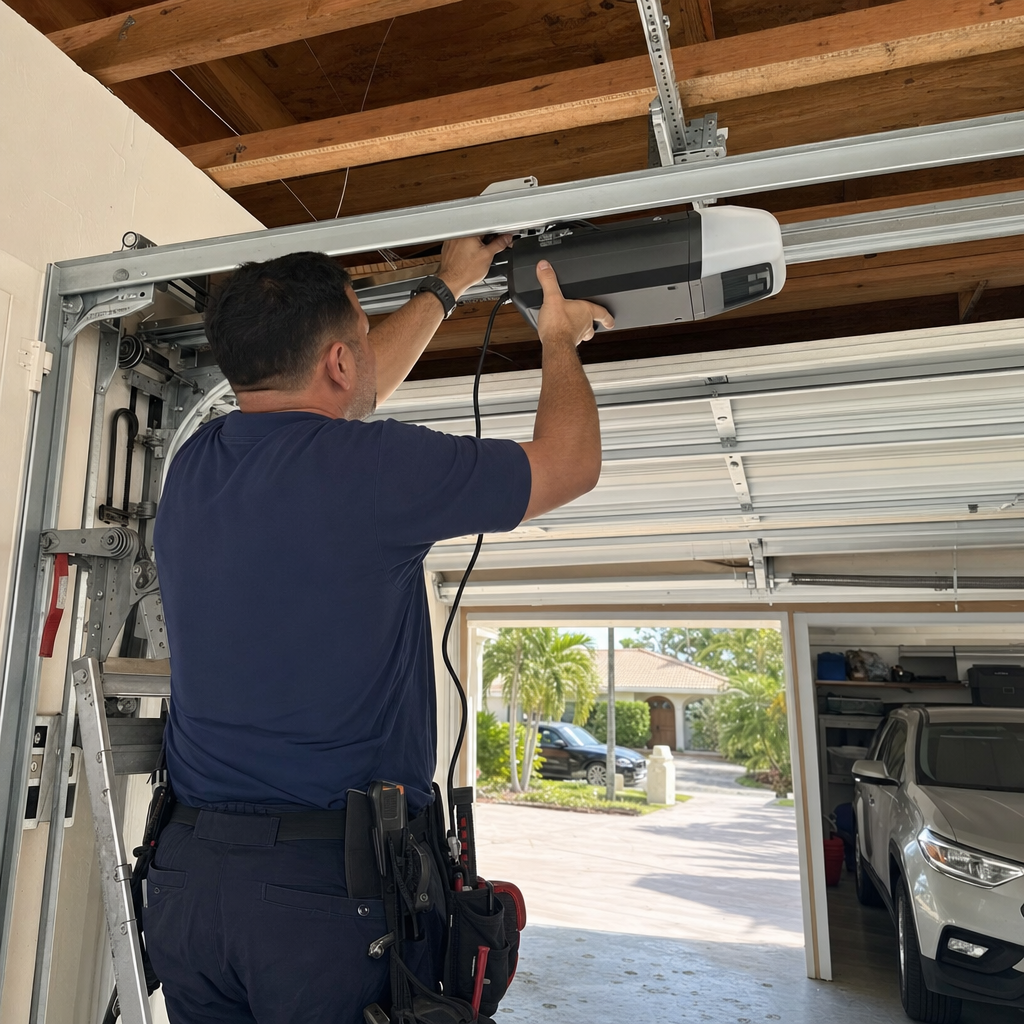
The owner shows up — and he’s your technician. At Apex Garage Door Service Florida home, Robert Garcia personally reviews every quote before it goes out, and he’s the same person who oversees the installation. That accountability changes how quotes get structured.
Hidden Costs After Low-Ball Quotes
We’ve been called to fix the aftermath of too many “great deals.” Here are the specific cost explosions that follow artificially low quotes in Miami:
- Non-compliant door replacement: The door passes initial installation but fails inspection. The permit is red-tagged. You’re now paying full price for a second door plus re-permit fees ($180–$420 again) plus the demolition of the first installation. We’ve seen $1,200 “deals” become $3,100 nightmares.
- Failed inspection re-permit fees: Miami-Dade charges for re-inspection after failure. Some municipalities add administrative fees. A contractor who doesn’t understand local inspection priorities — common with out-of-area crews who follow storms — racks these up on your dime.
- Structural modification surprises: Older Miami homes, particularly 1950s–1970s construction in Norland and West Little River, often have irregular rough openings or deteriorated wood framing. A quote that assumes “standard rough opening” without site inspection is gambling with your money.
- Opener incompatibility: The cheapest quote pairs a basic chain-drive opener with a heavy HVHZ door. Six months later, the opener fails prematurely. The “warranty” excludes overload damage. You’re buying a second opener.
- Haul-away surprises: “We’ll dispose of the old door” becomes “that’ll be $150 extra for the dumpster” after removal. Or worse: the crew leaves it in your alley, and Code Enforcement fines you.
Nearly 1,000 customers have rated us 4.7 stars — that’s not luck, that’s process. Our process includes site inspection before quoting, permit handling, and disposal included. The price we quote is the price you pay.
Garage Door Opener Costs and Smart Features
Opener selection significantly impacts total project cost and daily experience. Here’s our Miami-specific guidance:
| Type | Price Range (installed) | Best For | Miami Considerations |
|---|---|---|---|
| Chain drive | $280–$420 | Budget-focused, detached garages | Noisier; less ideal for bedrooms above garage (common in Miami townhomes) |
| Belt drive | $380–$580 | Attached garages, noise sensitivity | Best seller; handles HVHZ door weight well |
| Wall-mount (jackshaft) | $520–$780 | High-lift, limited headroom, ceiling storage | Ideal for Miami’s compact modern garages; requires side room for mounting |
| Smart-enabled (any type + module) | Add $80–$180 | Tech-integrated homes | WiFi reliability varies; we recommend hardwired internet backup for hurricane season |
We work on every major brand, so we diagnose fast and fix right. Our brand fluency includes Genie, Clopay, Amarr, and Wayne Dalton opener systems — meaning we don’t guess at compatibility or order wrong parts. For Miami homeowners, we particularly recommend belt-drive openers with battery backup: power outages during summer storms are common, and a garage you can’t access during an evacuation order is a genuine safety issue.
Smart features (MyQ, Aladdin Connect, similar platforms) add convenience but aren’t essential. In our experience, 60% of Miami homeowners who request smart openers use the app primarily for package delivery notifications — a real benefit in neighborhoods with porch piracy concerns.
Repair vs. Replace: The Real Math
When does repairing make financial sense versus full replacement? Here’s our decision framework from 11 years in Miami:
Repair is typically justified when:
- The door is under 12 years old and structurally sound
- Damage is isolated: one panel, one spring, failed opener
- The system has no prior HVHZ compliance issues (pre-2002 doors often don’t)
- Repair cost is under 40% of replacement cost
Replacement is typically justified when:
- The door is pre-HVHZ and you’re in a high-wind zone
- Multiple components are failing simultaneously (springs, cables, rollers, sections)
- Energy costs are excessive due to poor insulation
- You’ve already invested in two significant repairs within three years
In Miami specifically, we see accelerated wear patterns that shift the math. Salt air corrosion attacks bottom hardware faster than inland climates. The intense summer heat degrades weatherstripping and lubricants, increasing friction wear. A 10-year-old door in Miami often has the mechanical age of a 14-year-old door in Atlanta.
For Garage Door Repair in Norland and surrounding Miami neighborhoods, we offer free estimates that honestly assess repair viability. Sometimes the answer is repair; sometimes it’s replacement with explanation of why. When your door won’t move, we treat it like the emergency it is.
Permits, Inspections, and Miami-Dade Code Requirements
Permitting is where Miami garage door projects differ most from national norms. Here’s what actually happens:
- Application: The contractor submits a building permit application to the Authority Having Jurisdiction (AHJ) — Miami-Dade County for unincorporated areas, or the specific municipality (City of Miami, Coral Gables, Hialeah, etc.). Turnaround is typically 3–10 business days.
- Product approval verification: The building department verifies the proposed door has a valid Miami-Dade NOA or Florida Product Approval. This is the step where non-compliant doors get caught.
- Rough inspection (if applicable): For new construction or significant structural modification, a rough inspection confirms framing and electrical before door installation.
- Final inspection: The installed door is inspected for proper operation, safety feature function (auto-reverse, photo eyes), and label verification. The inspector confirms the installed door matches the approved product.
Permit costs vary by municipality. Miami-Dade County’s base residential garage door permit runs approximately $180–$280 for standard replacement. City of Miami adds administrative fees that push this to $280–$350. Coral Gables, with its additional architectural review requirements for visible street-facing doors, can reach $350–$420.
Some contractors suggest “pulling a homeowner permit” to save money. This makes you, the homeowner, legally responsible for code compliance and inspection outcomes. If the installation fails inspection, you’re the permit holder dealing with corrections. We handle permitting as part of our standard service because we’re accountable for the outcome.
Common Mistakes to Avoid
- Comparing Miami quotes to national averages. The $1,050 “national average” you found online assumes standard doors, no HVHZ, and minimal permitting. It’s not applicable here.
- Ignoring the wind-load sticker. Every compliant door has a permanent label stating design pressure. If your new door lacks this, it’s not HVHZ-compliant regardless of what you were told. Inspectors will red-tag it.
- Choosing price over product specificity. A quote without manufacturer and model is a quote without accountability. Demand specifics you can verify.
- Skipping the site inspection. Phone quotes based on “standard size” assumptions fail regularly in Miami’s diverse housing stock. The 1950s ranch in Miami Springs and the 2005 townhome in Brickell have very different installation realities.
- Neglecting opener-door weight matching. That heavy HVHZ door needs adequate opener capacity. Undersized openers fail prematurely and create safety hazards.
- Assuming all permits are equal. A permit pulled in Broward County doesn’t cover Miami-Dade work. Verify your contractor is permitting in the correct jurisdiction.
- Forgetting about electrical code. New opener installation in older Miami homes often requires GFCI-protected outlets. This isn’t door contractor work per se, but it’s your cost if unaddressed.
When to Call a Professional
Garage door springs operate under extreme tension — a broken spring or failed cable can cause serious injury or property damage without warning. We strongly recommend professional service for any spring, cable, or track issue. Similarly, if your door reverses unpredictably, makes loud grinding noises, or has visible panel separation, the safety systems may be compromised.
For planned upgrades, call when you’re ready for an honest assessment of repair versus replacement, with full transparency on HVHZ requirements and permitting. Garage Door Installation in Norland and throughout Miami — Apex Garage Door Service Florida offers free estimates. Call (888) 572-6026 and Robert Garcia will personally evaluate your situation.
Frequently Asked Questions
A complete installed replacement in Miami typically ranges $1,650–$3,400 for standard residential sizes, with HVHZ-rated doors starting around $1,850 total. High-end custom installations exceed $4,500. The variance comes from material choice, opener selection, and permit jurisdiction. Call (888) 572-6026 for a free, exact quote based on your specific door size and location.
The HVHZ compliance requirement adds 15–25% to material costs, and Miami-Dade permitting runs $180–$420 versus $50–$150 in many non-coastal markets. These are fixed costs driven by code, not contractor padding. A properly quoted Miami job includes these transparently.
No. Non-compliant doors fail inspection, cannot be legally permitted, and create insurance and resale liability. We’ve replaced multiple non-compliant doors that homeowners purchased online; the “savings” evaporated completely. Miami-Dade enforces this strictly.
Standard replacement takes 3–5 hours for experienced technicians. Permitting adds 3–10 business days before work can begin. We schedule installation promptly after permit approval and complete most jobs in a single morning or afternoon.
Repair is cheaper when damage is isolated and the door is under 12 years old with no compliance issues. Replacement becomes cost-effective when multiple components fail, the door is pre-HVHZ, or repair exceeds 40% of replacement cost. We provide free estimates to help you make this calculation accurately.
Galvanized steel with proper finish offers the best combination of HVHZ compliance, salt-air corrosion resistance, and value. Aluminum works well for modern aesthetics but dents more easily. We generally discourage fiberglass in Miami due to UV degradation. Wood composite is appropriate for specific architectural requirements with accepted maintenance obligations.
In Miami-Dade, opener-only replacement typically does not require a building permit if no electrical work is needed. However, if new circuitry, outlets, or panel work is required, permitting applies. We assess this during our free estimate and handle any required permits.
The Bottom Line
Miami garage door pricing in 2026 reflects real, unavoidable costs: HVHZ engineering, Miami-Dade permitting, and climate-appropriate materials. The homeowners who get the best value aren’t those who find the lowest quote — they’re those who understand what they’re paying for and can identify which line items are fixed costs versus negotiable scope. Get specific quotes with verified product numbers, confirmed permit inclusion, and transparent disposal terms. The $400 difference between an Atlanta quote and a Miami quote isn’t profit — it’s compliance and safety that protects your home through hurricane season and beyond.
11 years, one focus: garage doors done correctly. Whether you need Garage Door Opener in Norland, emergency repair in Miami, or a full replacement with honest pricing, we’re here to help. Call (888) 572-6026 for your free estimate — Robert Garcia will personally assess your door and provide a detailed, no-surprise quote.
Written by Robert Garcia, Owner & Lead Technician at Apex Garage Door Service Florida, serving Miami since 2015.