
Last updated July 7, 2026
Garage Door Warning Signs: A Miami Homeowner’s Reference Guide
Here’s a counterintuitive fact we see in Miami nearly every week: the garage doors that fail catastrophically often looked “a little noisy” or “slightly slow” for months beforehand. In our 11 years serving this city, we’ve found that salt air, hurricane-season humidity cycles, and limestone soil settlement create a unique fingerprint of wear that Miami homeowners can learn to read early. This guide will teach you to distinguish the cosmetic quirks you can monitor from the structural warnings that demand same-week attention — before you’re stuck with a door that won’t open during a afternoon thunderstorm or, worse, one that crashes down unexpectedly.
Quick Answer
The most critical garage door warning signs for Miami homeowners are: salt-air corrosion on springs and cables (visible as orange-brown flaking or swelling), shuddering or jerking during operation (often indicating humidity-damaged components), and any new noise paired with visible track misalignment. After hurricanes or tropical storms, check for subtle frame shifts and wind brace damage even if the door appears to work normally. These Miami-specific failure patterns progress faster than in drier climates due to our year-round moisture exposure.
Table of Contents
- How Salt Air Corrosion Shows Up on Miami Garage Doors
- Noisy vs. Structural: Decoding What Your Door Is Telling You
- Post-Hurricane Warning Signs Most Homeowners Miss
- Opener Failure Patterns in Miami’s Humidity
- The 60-Second Monthly Inspection Any Homeowner Can Do
- Spring and Cable Warning Signs That Demand Immediate Attention
- Track and Roller Wear in Coastal Climates
- Common Mistakes to Avoid
- When to Call a Professional
- Frequently Asked Questions
- The Bottom Line
How Salt Air Corrosion Shows Up on Miami Garage Doors
Miami’s proximity to the Atlantic and Biscayne Bay means salt particles ride on every sea breeze, settling on metal components that most homeowners never inspect. We’ve replaced springs in Coral Gables that looked five years old after just eighteen months, and cables in Miami Beach that were structurally compromised despite appearing “a little rusty” to the homeowner.
Here’s how to read corrosion stages on your garage door:
Early-stage corrosion: Fine surface discoloration — a dull gray or faint orange haze on springs, cables, or bottom brackets. The metal still feels smooth to a light touch. This is monitorable, not urgent, but worth noting.
Active corrosion: Visible flaking, pitting, or swelling of the metal surface. On torsion springs, you’ll see raised orange-brown patches where the protective coating has failed. On lift cables, the individual wire strands begin to separate and fray. This stage needs attention within weeks, not months.
Failure-stage corrosion: Sections of spring or cable where metal has visibly thinned, cables show “bird-caging” (strands bulging outward), or springs have measurable gaps between coils when the door is closed. At this point, the component is a safety hazard. We’ve seen cables snap during routine opening and springs release with enough force to damage vehicles — or worse.
The neighborhoods closest to open water — Garage Door Repair in Norland and coastal Miami — see accelerated corrosion, but even inland areas like Kendall and Doral experience significant salt-air exposure during onshore flow events. If you’re within three miles of the coast, inspect quarterly rather than annually.
One specific Miami factor: our limestone-rich soil and high water table create additional moisture migration through garage slabs. We’ve found that doors in homes with poor garage ventilation or slab moisture issues corrode 30-40% faster than identical installations with dehumidified or well-ventilated spaces.
Noisy vs. Structural: Decoding What Your Door Is Telling You
Every garage door makes some sound. The question is whether that sound represents normal mechanical operation or an early warning of component failure. In Miami’s climate, the distinction matters more than in drier regions because humidity accelerates the transition from “noisy” to “failed.”
Noises you can typically monitor:
- A steady, low rumble during opening and closing — often normal for steel doors with minimal insulation
- Light squeaking during the first cycle of the day that diminishes with use — usually dry rollers or hinges that need lubrication
- Clicking from the opener chain or belt — normal engagement sounds for Craftsman or older Raynor chain-drive units
Noises that signal structural concern:
- Grinding or metal-on-metal screeching — indicates rollers have failed or tracks are misaligned, causing the door to drag
- Popping or snapping sounds during operation — often a torsion spring with failing coils, extremely dangerous if it releases
- Irregular thumping or vibration — door panels may be separating, or the opener is struggling against unbalanced weight
- Sudden silence where motor runs but door doesn’t move — stripped opener gear or broken spring, immediate service needed
In our experience across Miami, the sound that most often precedes emergency calls is a rhythmic “clunk-clunk-clunk” during opening. This typically means a roller has jumped the track or a hinge has cracked, and the door is operating in a twisted configuration. Left unaddressed, this will bend the track or tear a panel — turning a $180 roller replacement into a $900+ track and panel job.
Here’s a practical test: stand inside your garage with the door closed. Have someone activate the opener while you watch from the side. A properly functioning door moves smoothly in the vertical track, transitions evenly through the curve, and rolls horizontally without side-to-side sway. Any visible wobble, especially paired with new noise, warrants professional inspection.
Post-Hurricane Warning Signs Most Homeowners Miss
After Hurricane Irma in 2017, we performed dozens of inspections where homeowners told us their door “worked fine” after the storm — yet we found critical damage that would have caused failure within weeks. Miami’s building code requires wind-rated garage doors, but even properly installed systems can sustain hidden damage during tropical weather.
Inspect these specific areas after any tropical storm or hurricane warning:
- Track mounting brackets: Look for pulled or elongated bolt holes where wind pressure flexed the door against the track. Even slight bracket movement changes track alignment and causes roller wear.
- Wind brace struts: These horizontal reinforcements on the interior of the door can bend or separate from panel attachment points. A visible bow in any strut means the door’s wind resistance is compromised for the next storm.
- Header and jam condition: Check the wood or metal framing around the door opening for cracks, separation, or fresh gaps between frame and wall. Miami’s older homes, especially in Little Havana and Allapattah, often have original wood framing that weakens with repeated moisture cycling.
- Opener rail deflection: The horizontal rail that connects opener to door should be perfectly level. If it sags or shows fresh scrape marks, the door encountered wind loads that stressed the entire system.
- Weather seal condition: Compressed, torn, or displaced bottom and side seals indicate the door flexed against its stops — a sign of significant wind pressure that may have stressed other components.
One case from 2022: a homeowner in Coconut Grove called us three weeks after a near-miss tropical storm because their door had developed “a little squeak.” Inspection revealed the top roller had pulled partially out of its bracket due to wind flex, and the door was operating with the roller tip barely engaged. Another storm cycle would have dropped the door from its track entirely. We secured the bracket, replaced the roller, and realigned the track — a $240 repair that prevented a potential injury.
Post-storm inspections are particularly important for Wayne Dalton and Clopay wind-rated doors with their specific brace configurations. These systems are engineered for specific load paths, and any brace or bracket displacement changes the entire structural calculation.
Opener Failure Patterns in Miami’s Humidity
Garage door openers are essentially small computers with motors attached — and computers hate humidity. In Miami, we’ve identified three distinct failure patterns that rarely occur in drier climates but represent the majority of our opener service calls from June through October.
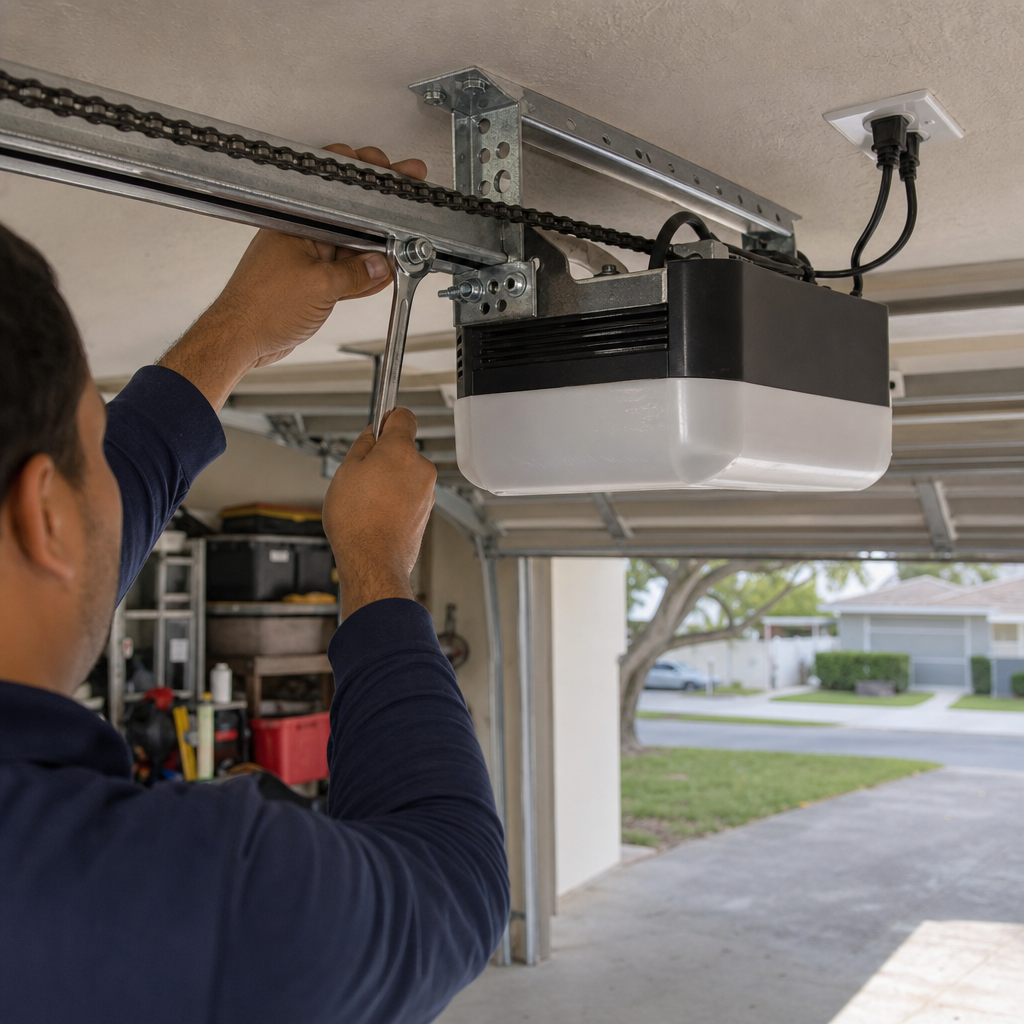
Logic board corrosion: The circuit board inside the opener motor housing controls all timing, force sensing, and safety reversal. Moisture infiltration — often through the vent slots on the motor cover — causes progressive corrosion of solder joints and component leads. Early signs include: intermittent response to remote or wall button (works sometimes, not others); shortened travel distance (door stops a foot short of fully open or closed); and phantom operation (door opens or closes without command, often in early morning when humidity peaks). We’ve replaced dozens of LiftMaster logic boards in Miami where the component showed no visible damage but failed conductivity testing due to microscopic corrosion.
Motor housing moisture: When humid air enters the motor housing and condenses on the armature and windings, the motor draws increased current and runs hotter. Symptoms include: burning smell during operation; motor that stalls under load but runs freely with door disconnected; and thermal shutdown (opener stops completely, then works again after cooling). This pattern accelerates dramatically in garages without climate control, which describes most Miami homes.
Intermittent safety sensor failure: The photo-eye sensors at the base of your door track use infrared beams that humidity can scatter or attenuate. In Miami’s summer mornings, we’ve seen sensors that work perfectly at noon fail consistently at 7 AM due to dew point and airborne moisture. If your door reverses for no visible obstruction, or works only at certain times of day, sensor alignment and shielding should be checked before replacing the opener.
One practical note: newer Genie and Chamberlain models with sealed “battery backup” housings tend to resist humidity better than openers with vented motor covers. If you’re replacing an opener in Miami, the enclosure design matters as much as the horsepower rating.
The 60-Second Monthly Inspection Any Homeowner Can Do
Professional maintenance is valuable, but monthly homeowner inspection catches most developing problems early. This routine requires no tools and takes under a minute once you’re familiar with it.
- Visual spring check (15 seconds): With the door closed, look at the torsion spring above the door or extension springs along the horizontal tracks. You’re checking for: gaps between coils (should be tightly wound when door is down); visible rust, flaking, or swelling; and any cable that appears frayed or separated. Do not touch — torsion springs store lethal energy.
- Balance test (20 seconds): Close the door and disconnect the opener (usually a red handle on a rope). Lift the door manually to waist height and release. A properly balanced door stays in place or drifts slowly. If it falls rapidly or shoots upward, the spring tension is wrong — a professional adjustment is needed.
- Track and roller scan (15 seconds): With door closed, visually inspect the vertical tracks for dents, separation from the wall, or visible rust. Look at each roller — they should sit squarely in the track, not tilted or partially emerged. Check that no roller is visibly cracked or missing its wheel.
- Opener operation note (10 seconds): Run one complete open-close cycle. Note any new sounds, hesitations, or irregular speeds. The door should move at consistent speed throughout, with no visible shaking or binding.
Keep a simple log — even phone notes work. “January: slight squeak from left side.” “March: squeak gone, but noticed rust spot on spring.” This history is invaluable when you do call for service, and it helps us diagnose faster when we arrive.
In Miami, we recommend doing this inspection monthly from May through November (hurricane and wet season) and every six to eight weeks December through April. The salt air doesn’t take vacations.
Spring and Cable Warning Signs That Demand Immediate Attention
We’re going to be direct about this: garage door springs are under extreme tension and can cause serious injury or death if they fail or are handled improperly. We’ve seen the aftermath of DIY spring attempts, and we include this warning because it’s our professional obligation.
Never attempt to adjust, repair, or replace torsion springs yourself. The winding cones store enough rotational energy to break bones or worse. Extension springs, while somewhat less dangerous, still require specific knowledge and tools for safe handling. If you observe any of the following, keep people and pets away from the door and call for professional service.
Critical spring warnings:
- Visible gap in the torsion spring body when the door is closed — indicates a broken spring, even if the door still operates with opener assistance
- Door feels “heavy” to lift manually or opener strains audibly — spring has lost tension and is forcing the motor to do the spring’s work
- Loud bang from the garage, often at night when temperature changes stress the metal — classic spring failure sound
- Spring appears elongated or coils are visibly separating when door is open — spring is failing and may not support the door in closed position
Critical cable warnings:
- Any fraying, especially if individual wire strands are protruding from the cable weave
- Cable appears slack or loose when door is in any position — should maintain consistent tension
- Cable has jumped its drum or pulley and is riding incorrectly
- Rust swelling that has changed the cable diameter — weakened cross-section will fail under load
In Miami’s salt-air environment, cable corrosion often progresses faster than spring failure because cables have more surface area exposed and are typically galvanized rather than oil-tempered like springs. We’ve replaced cables in coastal homes that showed advanced corrosion while the springs still had useful life.
The owner shows up — and he’s your technician. When you call Apex Garage Door Service Florida home about a spring or cable concern, Robert Garcia evaluates it personally and will tell you directly if immediate service is needed or if monitoring is appropriate.
Track and Roller Wear in Coastal Climates
While springs and cables get the most attention, track and roller failures cause the most “sudden” operational problems — doors that jam mid-cycle, come off their tracks entirely, or develop damaging metal-on-metal contact.
Track-specific warning signs:
Horizontal track sag is common in Miami due to a combination of factors: humidity-cycling of mounting hardware, limestone soil settlement affecting garage slab level, and the weight of wind-rated doors on support brackets. Look for visible downward bow in the horizontal track section, or fresh gaps between track and ceiling mounting points.
Vertical track misalignment often follows slab settlement or frame shifting. The door should run centered in the track with equal clearance on both sides. If you can see the door rubbing one side, or if the weather seal compresses unevenly, the track geometry has changed.
Rust on the interior track surface is particularly problematic — it creates roller drag that overloads the opener and accelerates roller wear. Light surface rust can sometimes be addressed; pitted or flaking track interior requires replacement.
Roller wear indicators:
Steel rollers develop flat spots, visible wear grooves, or bearing seizure that causes them to slide rather than roll. Nylon rollers — increasingly common on newer Clopay and Amarr doors — crack, chip, or develop bearing slop that allows wobble. Either type should rotate freely when you manually spin them (with door in down position and opener disconnected).
One Miami-specific pattern: roller failure clusters in homes near construction sites. The combination of airborne concrete dust and humidity creates an abrasive paste that destroys bearings in months rather than years. If you’re in a developing area like parts of Wynwood or the Edgewater corridor, inspect rollers quarterly.
For homeowners considering Garage Door Installation in Norland or elsewhere in Miami, we specify sealed-bearing steel rollers or high-cycle nylon for coastal applications — the upfront cost difference is modest, but the service life extension is substantial.
Common Mistakes to Avoid
- Ignoring seasonal changes as “normal.” A door that worked fine in January but groans in July isn’t just “settling in” — humidity has changed something, and that something rarely fixes itself.
- WD-40 as a lubricant. This product displaces water but provides no lasting lubrication, and its solvent base can degrade nylon rollers and plastic opener components. Use silicone-based or lithium-based garage door lubricants only.
- Testing the auto-reverse with a wooden block. Federal safety standards specify a 2×4 board test, but many Miami homeowners use smaller objects that don’t properly verify force settings. A failing reversal system can crush a pet or child — test correctly.
- Assuming post-hurricane damage is obvious. We’ve found critical frame and track issues in doors that “looked fine” and operated normally after storms. Subtle misalignment progresses to failure over weeks or months.
- Delaying service until complete failure. A spring that’s lost 20% tension costs less to replace than one that’s broken and potentially damaged the opener, cables, and panels. Early intervention saves money and prevents emergencies.
- Hiring unvetted handymen for complex repairs. Garage doors are specialized systems with significant safety considerations. We’ve been called to fix botched repairs that cost more than our original quote would have — and created safety hazards in the meantime.
- Neglecting opener maintenance while focusing only on the door. The opener is half the system. Logic board issues in Miami’s humidity can develop silently until sudden failure leaves you locked out or unable to secure your home.
When to Call a Professional
Call for same-day service if your door is stuck open, stuck closed with vehicles inside, has a broken spring or cable, has come off its tracks, or shows any sign that it might fall or drop unexpectedly. These are safety hazards, not scheduling inconveniences.
Schedule within the week for: new or worsening noises with visible operational change; opener intermittent operation or thermal shutdown; post-hurricane inspection regardless of apparent function; or any corrosion that has progressed beyond surface discoloration.
Monitor and plan for: cosmetic rust on non-structural hardware; minor weather seal wear; or purely aesthetic panel damage that doesn’t affect operation.
When you need a professional who understands Miami’s specific conditions, Garage Door Opener in Norland and throughout the metro area, Apex Garage Door Service Florida offers free estimates. Nearly 1,000 customers have rated us 4.7 stars — that’s not luck, that’s process. Call (888) 572-6026 to speak with Robert Garcia directly.
Frequently Asked Questions
Most common repairs in Miami range from $180 for roller or hinge replacement to $340 for spring or cable service. Opener repairs typically run $150–$280, while full track realignment averages $220–$400 depending on damage extent. Salt-air corrosion can increase costs if multiple components need simultaneous replacement. Call (888) 572-6026 for an exact quote — estimates are free.
Homeowners can safely lubricate hinges, rollers, and track surfaces with proper garage door lubricant. Avoid the torsion spring, cables, and opener internal components — these require professional knowledge and present injury risk. In Miami’s humidity, we recommend lubrication every three months rather than the standard six-month interval. If you’re unsure which product to use or which components to avoid, we’re happy to walk you through it by phone.
Intermittent operation in Miami almost always traces to humidity effects: moisture-scattered safety sensor beams, logic board connections that fail at high humidity and conduct at lower levels, or motor thermal protection that triggers more easily when the motor housing retains moisture. Track expansion from temperature-humidity cycling can also cause binding on extreme days. These patterns are diagnostic — they point to specific components that need attention before complete failure.
For doors under 15 years with single-component failure (spring, cable, opener), repair is almost always more economical. Replacement becomes cost-effective when: multiple components have failed simultaneously; the door lacks current wind rating for Miami-Dade code; panels are damaged or discontinued; or repair costs exceed 50% of replacement. We work on every major brand, so we diagnose fast and fix right — we’ll tell you honestly when replacement makes more sense.
We recommend annual professional inspection and tune-up for most Miami homes, increasing to semi-annual if you’re within two miles of the coast, have an unventilated garage, or operate the door more than four cycles daily. Professional service includes spring tension verification, hardware torque check, opener force and safety testing, and component wear assessment that goes beyond homeowner visual inspection.
Yes — emergency garage door service is a core offering, not an upsell. When your door won’t move, we treat it like the emergency it is. Same-day availability depends on call volume and your location within our Miami service area, but we prioritize lock-outs, safety hazards, and doors stuck open. Call (888) 572-6026 and we’ll give you a realistic arrival window.
The Bottom Line
Miami garage doors face a unique stress profile: salt air corrosion, humidity cycling, hurricane wind loads, and limestone soil settlement create warning signs that differ from drier climates. The homeowners who avoid emergency calls are those who learn to read these signs early — distinguishing monitorable surface rust from active cable corrosion, recognizing when noise indicates structural misalignment, and performing simple monthly inspections that catch problems before they strand you or create safety hazards. 11 years, one focus: garage doors done correctly. Whether you’re monitoring a developing concern or facing an urgent failure, informed observation paired with professional response when needed keeps your door reliable through every Miami season.
Written by Robert Garcia, Owner & Lead Technician at Apex Garage Door Service Florida, serving Miami since 2015.